 Miles
Miles Getting started
How to Start Running When You're Out of Shape
Every runner you have ever seen glide past you started from zero. Out of breath after a minute, wondering if their body was built for this. It was, and yours is too. Here is how to start in a way you can actually sustain.
Everyone starts from zero
There is no fitness bar you have to clear before you are allowed to start running. If you can walk for 30 minutes, you can start the progression below this week. "Out of shape" just means your starting point is week 1 instead of week 5, and the plan works the same either way.
The one thing worth knowing up front: your heart and lungs will adapt faster than your tendons, joints, and muscles. In the early weeks you will often feel aerobically fine while your legs are still catching up. That gap is why almost every beginner injury comes from doing too much too soon, and why the first month is deliberately gentle.
The first four weeks
Do not start by running. Start by walking, then mix short running intervals into the walks. Three sessions a week, with at least one rest day between them, and every session judged by effort, not pace.
| Week | Session (3x per week) | Focus |
|---|---|---|
| 1 | Brisk walk 30 min | Build the habit, wake up the legs |
| 2 | Walk 4 min / run 1 min × 6 | Short runs, full recovery between them |
| 3 | Walk 3 min / run 90 sec × 6 | Slightly longer runs, still easy effort |
| 4 | Walk 2 min / run 2 min × 6 | Even split; every run at talking effort |
If week 4 feels manageable, you are ready to keep extending the run intervals; our couch to 5K training plan picks up exactly here. If any week feels like too much, hold at that week or shrink the run intervals. That is not falling behind. That is the plan fitting you.
How slow should you go? Slower than that
The single biggest beginner mistake is pace. Most people run their first intervals at a pace they could hold for about 60 seconds, then conclude running is misery. Real easy running is dramatically slower than what your brain pictures when it hears the word "run."
Running this slowly can feel embarrassing at first. It should not. It is exactly how experienced runners do the majority of their own training, and it is the only version of running your body can adapt to three times a week without breaking.
Keep the gear minimal
You need running shoes that fit and feel comfortable, and clothes you do not overheat in. That is the list. A proper fitting at a running store is worth it if your shoes are old, but you do not need a watch, a heart rate strap, compression anything, or special socks to start. Your phone can track the run, and week 1 fitness does not care what brand is on your feet. Buy the rewards later, when the habit has earned them.
How often should you run?
Three days a week, on non-consecutive days. That frequency is enough to drive real adaptation while leaving your legs a full recovery day between sessions, which is where the actual improvement happens. Running on back-to-back days is a privilege your tendons earn after a few months, not a shortcut.
On the days between runs, walking is genuinely useful, and doing nothing is also fine. What matters is that the three run days keep happening, week after week. Consistency at three days beats an enthusiastic five-day week followed by two weeks on the couch. When three days starts to feel easy, read our guide on how many days a week to run before adding a fourth.
Signs you are doing too much
- Pain that changes how you move. Muscle soreness that fades as you warm up is normal. Pain that sharpens during a run, or makes you limp, means stop and take extra rest days.
- Soreness that lasts more than 48 hours after a session. The session was too big; shrink the next one.
- Dreading every single run. Some reluctance is normal. Constant dread usually means the effort is too high, so slow the intervals down.
- Sleep getting worse instead of better. Training load that exceeds recovery shows up in sleep early.
- Resting heart rate creeping up over several days. A classic early flag that you need an easier week.
None of these mean you failed. They mean the dose was slightly wrong, and the fix is always the same: smaller step, more recovery, carry on.
How Miles gets you started
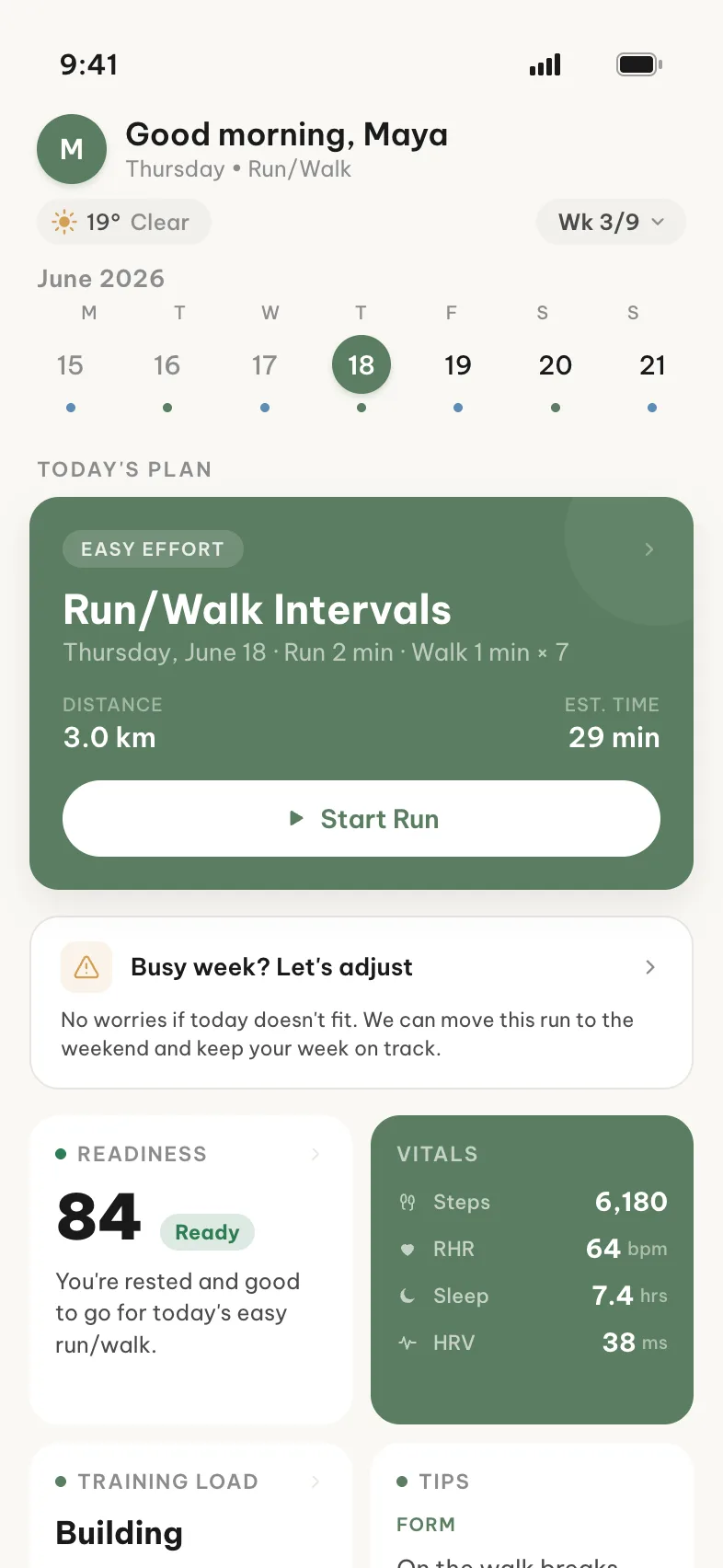
Everything above still leaves you with daily decisions: how far, how fast, whether today should be a run at all. Miles makes those decisions for you.
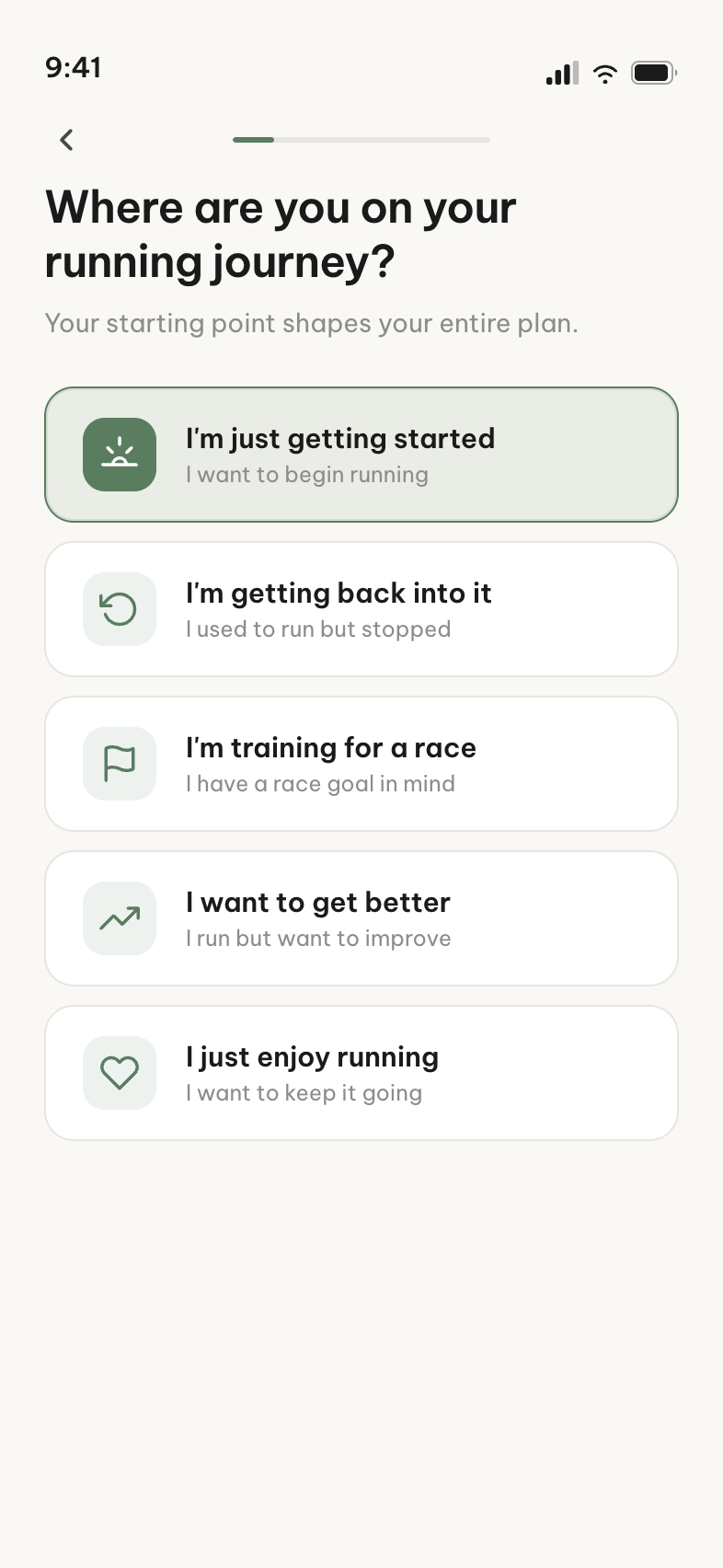
- The plan starts from your actual fitness. A few questions plus your Apple Health data give Miles your real starting point, and the plan builds up from there. It meets you where you are now, not where a generic program assumes you are.
- The daily brief removes the guesswork. Open the app and today's session is right there: what to run, how long, and why. No spreadsheet, no deciding while standing in the doorway.
- It is readiness-aware. Miles factors in how you have been recovering, so it never throws you into a session your body is not ready for. When you need an easier day, the plan reflects that before you have to figure it out yourself.
- Audio cues keep the pace in check. During the run, Miles tells you when you are pushing way too fast, which is the mistake that ends most beginner attempts. The talk test, enforced in your ear.
Start running with a coach in your pocket
Miles builds a plan from your actual starting point and tells you exactly what to do each day. Available on iPhone.