 Miles
Miles Coming back
How to Get Back Into Running After a Break (Without Repeating Week One Forever)
An injury, a new baby, a busy year, or just life. Coming back to running is not the same as starting from zero, but it is not picking up where you left off either. Here is how to restart at the right level and rebuild without getting hurt again.
The comeback trap
The hardest thing about returning to running is that your memory of fitness outlasts the fitness itself. You remember what a comfortable six-miler10K felt like. You remember your tempo pace. Your brain still holds the map, but your tendons, ligaments, and aerobic system have quietly handed back some of the territory.
That mismatch is where most comeback injuries happen. Your cardiovascular system rebounds fairly quickly, so within a couple of weeks a run can feel fine. Connective tissue adapts far more slowly, on a timescale of months, not weeks. Ego pacing, running the paces your old self ran because they still feel like "your" paces, loads structures that are not ready for it. The result is the classic returner arc: two great weeks, one sore shin, six weeks back on the couch.
The fix is not caution forever. It is starting at the right level, then progressing on a returner's curve, which is steeper than a beginner's but flatter than your memory wants.
How much to run, by length of layoff
A rough starting point, keyed to how long you were away. These are guidelines for a healthy return; if you stopped because of an injury, get the injury cleared first and start at the lower end of each range.
| Time off | Where to restart | Notes |
|---|---|---|
| Under 2 weeks | Resume your plan at slightly reduced volume | Almost nothing is lost. Trim the first week back by 10 to 20 percent, then continue as normal. |
| 2 weeks to 1 month | About 70 to 80 percent of your old weekly volume | Easy running only for the first week. Expect paces to feel a touch harder than you remember. |
| 1 to 3 months | About 50 to 70 percent of your old weekly volume | Rebuild over 3 to 6 weeks before touching your previous mileage. All easy effort at first. |
| 6 months to several years | Treat yourself as a near-beginner | Start with short, easy runs, walk breaks welcome. You will progress faster than a true beginner, but the first weeks should look like theirs. |
The near-beginner label after a long layoff is about tissue tolerance, not identity. Your bones and tendons need the same gradual reloading a new runner's do. What is different is what happens next: a returner can usually add volume every week where a true beginner needs to repeat weeks, and the plateau phases are shorter.
Rebuild by effort, not by your old paces
For the first two to four weeks back, ignore pace targets entirely. Run by feel: an easy effort where you could hold a full conversation. Check the watch after the run if you must, but do not chase a number during it.
This matters because your old paces are calibrated to a body you do not currently have. Effort self-adjusts to your real fitness on any given day; a pace target from six months ago does not. Runners who come back by effort tend to arrive at their old paces within weeks anyway, and they arrive uninjured.
Good news: it comes back faster the second time
The comeback is genuinely easier than the first build. Muscle memory is real: previously trained muscle retains cellular adaptations that make retraining faster than initial training. Your aerobic base also returns quicker than it was built, and you already own the things beginners struggle with most, running form, pacing instinct, and the knowledge of what a training week feels like.
Practically, that means a returner who restarts at 50 percent of old volume can often be back near full volume in 6 to 10 weeks, a progression that would be reckless for a first-time runner. The curve is faster. It just is not instant, and it is not week one on repeat either. If you find yourself running the same two easy miles for a month out of fear, you have overcorrected: progress a little every week you feel good.
When to add back speed work
Hold off on intervals and tempo runs until three boxes are ticked:
- You have 3 to 4 weeks of consistent easy running at your rebuilt volume with no niggles.
- Your easy runs feel easy again. Same route, conversational effort, no next-day soreness.
- You have reintroduced strides. A few 20-second relaxed accelerations at the end of easy runs are the bridge back to real speed work. Do these for a week or two first; they sharpen the legs with almost no injury cost.
When speed work does return, start with shorter reps at controlled effort and about half the session volume you used to do. Speed is the last thing to come back and the first thing to hurt you if you rush it.
How Miles handles a comeback
Everything above is calibration work: figuring out where you actually are, versus where you remember being. That is exactly what Miles is built to do.
- The plan meets you where you are now, not where you used to be. Miles builds your training from your current fitness, so week one is pitched to today's body, not last year's race times.
- Starting fitness from a few questions plus Apple Health. Answer a short setup, connect Apple Health, and Miles establishes a baseline instead of asking you to guess your own volume.
- A readiness-aware daily brief. Open the app and see what today's run is and how recovered you are, so early comeback weeks stay calibrated rather than guessed.
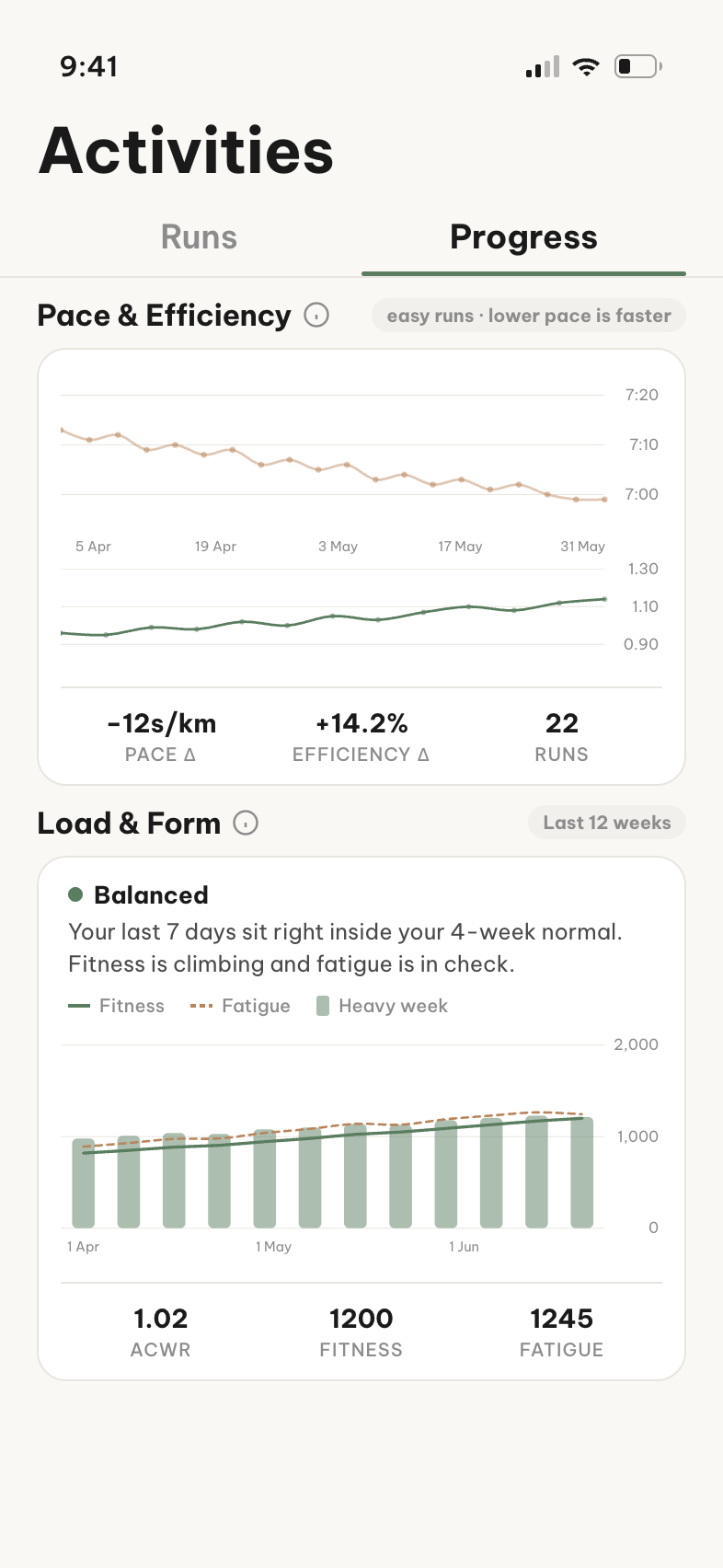
- Progress you can see. Weekly pace and efficiency trends, plus load and form, show the fitness returning, which is the returner's best antidote to ego pacing: proof the patient route is working.
Come back at the right level
Miles builds a plan from where you are today and progresses it as your fitness returns. Available on iPhone.