 Miles
Miles Plan trouble
Missed a Week of Training? Here's How to Adjust Your Running Plan
Illness, work, a niggle, a holiday. A missed week feels like the plan is broken. It is not. Here is what the gap actually costs, what to change, and what to leave alone.
First, the honest numbers
A study of nearly 300,000 marathoners' training logs by Feely, Smyth and colleagues, published in Frontiers in Sports and Active Living, tracked what training gaps in a 12-week build did to race day. Runners who missed 7 to 13 days ran about 4.25 percent slower than in an uninterrupted build. Two weeks off cost a little over 6 percent, and three weeks about 7.5 percent.
Read those numbers again, because they cut both ways. A missed week does not erase your fitness: you keep the vast majority of what you built. But it is also not free, so the plan you rejoin should not pretend the week happened.
What to do, by length of gap
Missed 1 to 3 days
Skip them. Rejoin the plan exactly where it is today. Do not shuffle runs forward, do not double up. A couple of missed easy runs have no measurable effect on race day.
Missed 4 to 7 days
- Rejoin at reduced volume. Run your first week back at roughly 70 to 80 percent of what the plan originally scheduled, then resume as written.
- Keep the key sessions, shrink them. If the week had a long run and an interval session, do both, but cut the long run distance and the rep count.
- Skip the missed long run if it was early in the plan. A missed long run in the first half of a training block generally does not need making up at all.
Missed 2 to 3 weeks
- Step the plan back, don't cram it. Restart from a week you have already completed comfortably, usually two to three weeks earlier in the progression.
- Reset your paces. Expect the same effort to come at a slightly slower pace for a week or two. That is normal and temporary.
- Re-examine the goal, not the runner. If the race is close, the distance is still on. The finish time estimate is what moves, and it often moves less than you fear.
Missed a month or more
That is no longer an interrupted plan, it is a fresh start from a new baseline. Treat it as a comeback: our guide on getting back into running after a break covers exactly how to rebuild without repeating week one forever.
Which workouts matter most when you rejoin
| Session | Priority | Why |
|---|---|---|
| Long run | Highest | Drives endurance adaptation; the backbone of any race plan |
| Quality session (intervals or tempo) | High | Maintains speed and running economy; one per week is enough after a gap |
| Easy runs | Flexible | Fill volume; the first to shrink and the last to worry about |
| Strides and drills | Keep | Cheap to do, keep the legs sharp, add almost no fatigue |
The mistakes that turn a gap into an injury
- Doubling up runs to hit the original weekly mileage. Your tendons do not care what the spreadsheet said.
- Racing your old paces immediately. After illness especially, run by effort for a week before chasing pace targets.
- Jumping any single run by more than about 25 percent over what was originally scheduled for that day.
- Ignoring why you missed the week. If it was a niggle, the cause is still there. Rejoining at lower volume is your chance to fix it.
How Miles handles a missed week for you
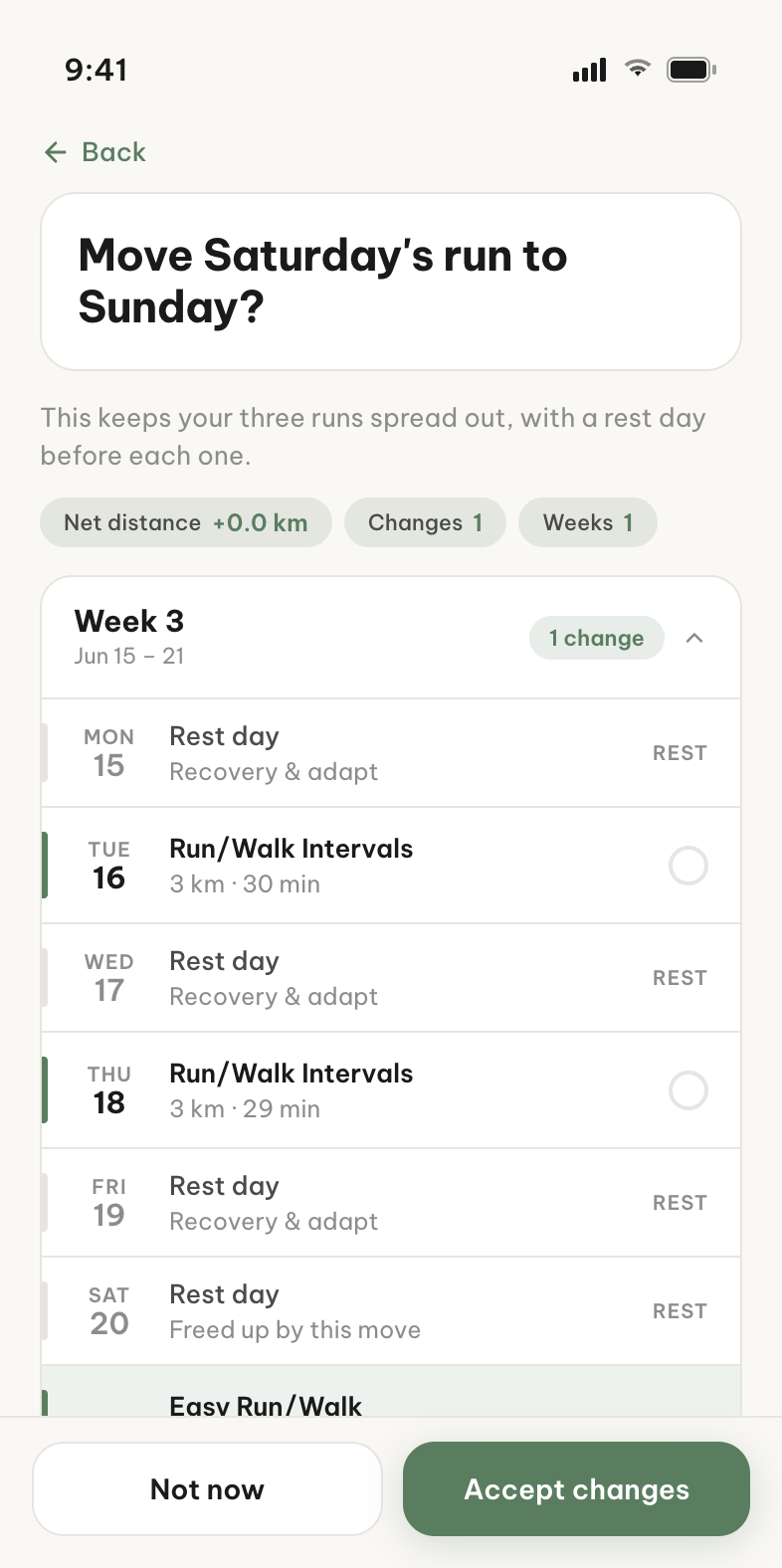
Everything above is judgement work: how much to keep, what to cut, when to rejoin. It is exactly the work a human coach does when you text them "I was sick all week." Miles does that work automatically.
- The plan reflows, not restarts. When runs get missed, Miles redistributes the training that matters across the weeks you have left and drops what does not need making up. You never see a wall of red missed workouts.
- You approve every change. Miles shows you the proposed reshuffle, what moves, what shrinks, what stays, with the reasoning, and you accept it in one tap.
- Your goal stays your goal. Miles adjusts the path to race day rather than lowering the target the moment life happens. The projected finish time updates honestly as you train.
- Recovery is part of the math. The daily readiness brief factors in how you have been recovering, so your first week back is calibrated, not guessed.
Never do missed-week math again
Miles builds your plan, and rebuilds it when your week falls apart. Available on iPhone.