 Miles
Miles Race training
Half Marathon Training Plan for Beginners: Your 12-Week Guide
13.1 miles21.1 kilometres sounds enormous until you break it into twelve weeks of ordinary runs. Here is what a beginner half marathon training plan actually looks like: who is ready to start, what a week contains, and how the long run grows without breaking you.
Are you ready to start a 12-week build?
A 12-week half marathon plan assumes you already run a little. You do not need speed, racing history, or an athletic past. You need two things:
- You can run about 30 minutes continuously. Slowly is fine. Walk breaks here and there are fine too, but the bulk of it should be running.
- You are running roughly 10 to 15 miles16 to 24 km per week, spread over three or more days, and have been for a few weeks.
If you are not there yet, that is not a problem, it just means the half marathon build starts later. Spend four to eight weeks getting to a comfortable 30-minute run first. Starting a race plan from zero is the most common way beginners get hurt, because the long run grows faster than tendons and joints adapt.
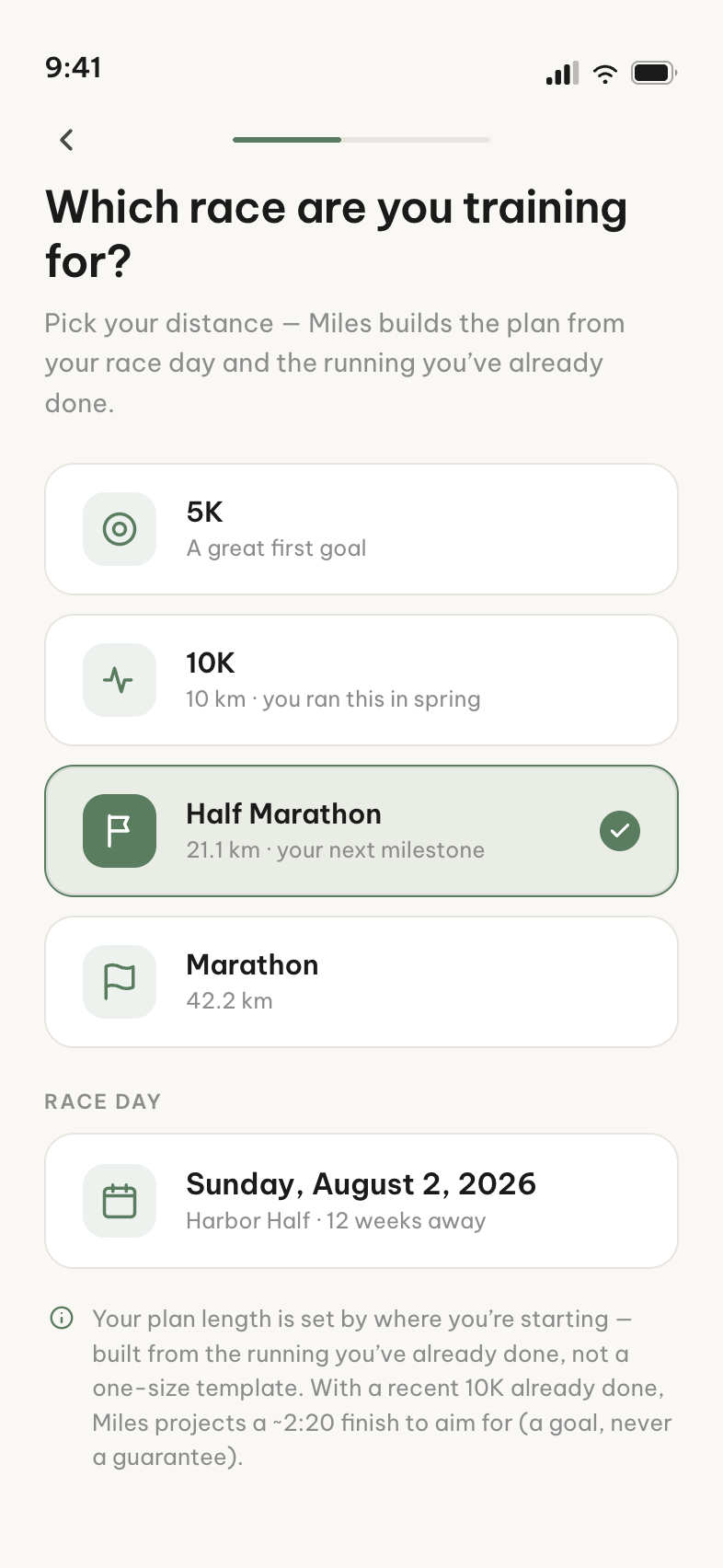
What a training week looks like
Almost every beginner half marathon plan is built from the same three ingredients, run three to five days per week:
- One long run. The backbone of the plan. It teaches your body to burn fuel efficiently and spend time on your feet. It is run slower than you think it should be.
- One quality session. A tempo run, intervals, or hill repeats. This is the one hard day of the week, and one is enough for a first half marathon.
- Easy runs. Everything else. These fill in the weekly mileage at a conversational pace and do most of the quiet aerobic work.
Three days a week is a legitimate half marathon plan. Four is the sweet spot for most beginners. Five works if you already have the habit. More days does not mean more fitness if the extra days cost you recovery.
The 12-week long-run progression
The single number that matters most in a beginner plan is the long run. Here is a typical progression. Notice the pattern: it climbs, steps back every few weeks, peaks at 10 to 11 miles16 to 18 km, then drops for the taper.
| Week | Long run | Focus |
|---|---|---|
| 1 | 3 miles5 km | Establish the routine, all easy running |
| 2 | 4 miles6 km | Add a short tempo segment midweek |
| 3 | 5 miles8 km | Build volume gently |
| 4 | 4 miles6 km | Cutback week, let the body absorb |
| 5 | 6 miles10 km | Longest run of your life for many, keep it slow |
| 6 | 7 miles11 km | Practice mid-run fueling |
| 7 | 8 miles13 km | Quality session gets slightly longer |
| 8 | 6 miles10 km | Cutback week |
| 9 | 9 miles14 km | Rehearse race-day breakfast and gear |
| 10 | 10 to 11 miles16 to 18 km | Peak long run, the confidence maker |
| 11 | 8 miles13 km | Taper begins, volume drops, legs freshen |
| 12 | Race | Two or three short easy runs, then 13.1Two or three short easy runs, then 21.1 |
You never run 13.1 miles21.1 km in training, and you do not need to. If you can run 10 to 11 miles16 to 18 km two weeks out, race-day adrenaline, crowds, and fresh tapered legs carry the rest.
Fueling and easy-day discipline
Two habits separate beginners who arrive at the start line healthy from those who do not:
- Run your easy runs genuinely easy. Conversational pace, meaning you could speak in full sentences. Most beginners run easy days too fast, arrive at the quality session tired, run it too slow, and end up with a week of grey, medium-effort running that trains nothing well.
- Practice fueling on long runs from about week 6. Once long runs pass roughly 75 minutes, take carbohydrate during the run, a gel or chews every 30 to 40 minutes, with water. Race day is the wrong time to discover a gel that upsets your stomach.
Race-week basics
- Do less than feels right. Two or three short easy runs, maybe a few strides. Fitness is banked; the only thing left to gain is freshness.
- Nothing new on race day. Shoes, socks, breakfast, gels: all rehearsed on long runs.
- Start slower than you want to. The first three milesfirst five kilometres should feel too easy. Every minute you save in mile onethe first kilometre by going out hot costs several at mile elevenkilometre eighteen.
- Have a pace plan, loosely held. A realistic target range beats a single hard number, because weather and course will have opinions.
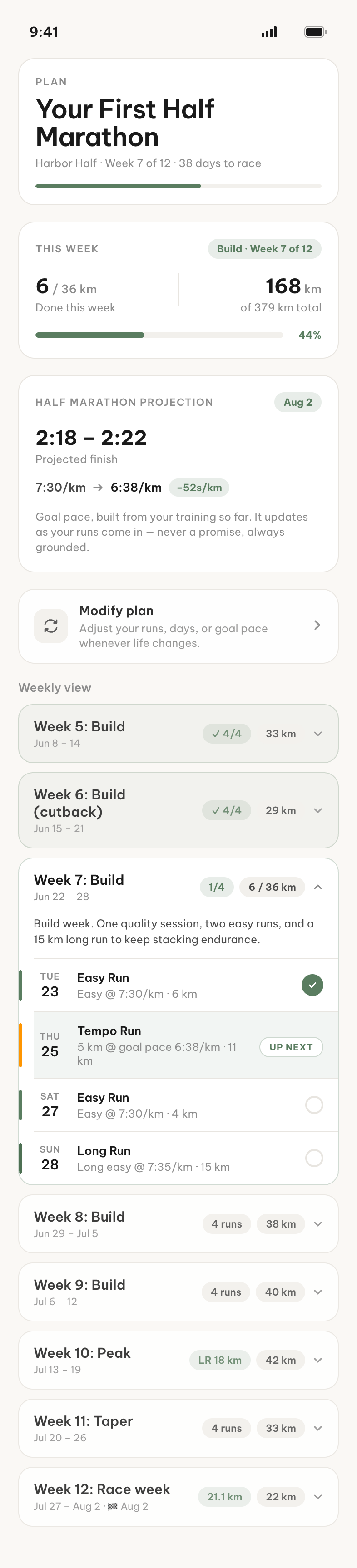
How Miles builds your half marathon plan
Everything above is the generic version: a template that assumes an average runner with an average schedule. Miles builds the specific version for you.
- Plan length comes from your fitness and your race date. Twelve weeks is a default, not a law. Miles looks at where you are today and how far out the race is, and sizes the build accordingly, adjusting to tight timelines without rushing you into injury.
- You get a projected finish time that updates as you train. Not a guess made once at sign-up, but a range that moves with your actual runs.
- Every session has a stated purpose. You see why a tempo run is on Thursday and what it is building, not just a distance to tick off.
- The plan reflows when your week changes. Miss a run, move a day, get sick: Miles redistributes the training that matters across the weeks you have left instead of leaving a wall of missed workouts.
- The taper is recovery-aware. Volume drops on a schedule informed by how you have actually been recovering, protecting sharpness without overreaching.
Get a half marathon plan built for you
Miles builds your plan from where you are today, guides your pace in real time, and adapts when life happens. Available on iPhone.