 Miles
Miles Training frequency
How Many Days a Week Should You Run?
The short answer: 3 days if you are new or running for fitness, 4 to 5 for most race goals, and 6 or more only if you are an experienced runner building serious mileage. Here is how to pick your number, and what to put on each day.
The answer up front
Three days a week is enough to get fitter, build a running habit, and finish a 5K or 10K. Four to five days is the sweet spot for most race goals from 10K to marathon: enough volume to drive real adaptation, with enough rest to absorb it. Six or seven days belongs to experienced runners who have built up to high mileage over years and whose bodies have proven they recover from it.
More days is not automatically better training. Each run only makes you fitter if you recover from it, so the right frequency is the highest one you can absorb, not the highest one you can survive.
Days per week, by goal and experience
| Goal | New runner (0 to 1 years) | Regular runner (1 to 3 years) | Experienced runner |
|---|---|---|---|
| General fitness | 3 | 3 to 4 | 4 to 5 |
| 5K | 3 | 3 to 4 | 4 to 5 |
| 10K | 3 to 4 | 4 | 4 to 5 |
| Half marathon | 3 to 4 | 4 to 5 | 5 to 6 |
| Marathon | 4 | 4 to 5 | 5 to 6+ |
Two patterns worth noticing. First, goal distance raises the floor: you can finish a marathon on 4 days a week, but not on 2. Second, experience raises the ceiling more than the floor. A first-time marathoner on 4 well-structured days is following a sound plan; a first-time marathoner on 6 days is following a fast track to injury.
Rest days are training
The workout is the stimulus; the adaptation happens in the recovery. When you run, you create microscopic muscle damage, deplete fuel stores, and stress tendons and bone. In the 24 to 48 hours afterwards, your body rebuilds those tissues slightly stronger than before. Skip the rebuilding window and you stack stress on stress: fitness stalls, legs stay heavy, and injury risk climbs.
So a rest day is not a day you failed to train. It is the day the training you already did gets converted into fitness. This is also why frequency has a personal ceiling: runners differ widely in how fast they recover, and age, sleep, stress, and training history all move that number.
Consistency beats volume
If you remember one thing from this page: 3 days every week beats 5 days every other week. Aerobic fitness is built by repeated stimulus over months, and it decays during gaps. An on-off pattern means you spend half your time rebuilding what the off weeks let slip, while the on weeks hit a body that lost some of its tolerance.
What goes on which day
Whatever your frequency, a good week has the same skeleton: one long run, at most one or two quality sessions, and easy running for everything else. The long run and the quality session should never sit on consecutive days.
3 days a week
One long run (usually the weekend), one quality session mid-week (intervals or tempo), one easy run between them. Example: Tuesday quality, Thursday easy, Sunday long.
4 days a week
Same skeleton plus one more easy run. Example: Tuesday quality, Wednesday easy, Friday easy, Sunday long. The extra easy day adds aerobic volume without adding hard stress.
5 days a week
Now there is room for a second quality session, if your body handles the first one well. Example: Tuesday intervals, Wednesday easy, Thursday tempo, Saturday easy, Sunday long. Many runners are better served keeping the fifth day easy and simply carrying more volume.
Signs you should drop a day
- Easy runs stop feeling easy. Same effort, slower pace, elevated heart rate for days at a time.
- Niggles that rotate. A calf one week, a knee the next: your structures are queueing up to complain about the load.
- Sleep and mood degrade. Persistent tiredness, irritability, or dreading runs you used to enjoy are classic overreach signals.
- You keep missing the same day. If Thursday falls through three weeks running, the schedule is wrong, not you. Plan the week you actually live.
Dropping from 5 days to 4 while keeping the long run and the quality session costs you very little fitness. Grinding through 5 days under-recovered costs you weeks.
How Miles builds your week around your days
The right frequency is personal, and it changes. Miles treats your available days as the starting point of the plan, not an afterthought.
- It asks which days you can actually train. The plan is built around the days you give it, with the long run and quality sessions placed correctly among them.
- Plans from 5K to marathon at your frequency. Whether you have 3 days or 6, Miles structures the goal around the schedule you really have.
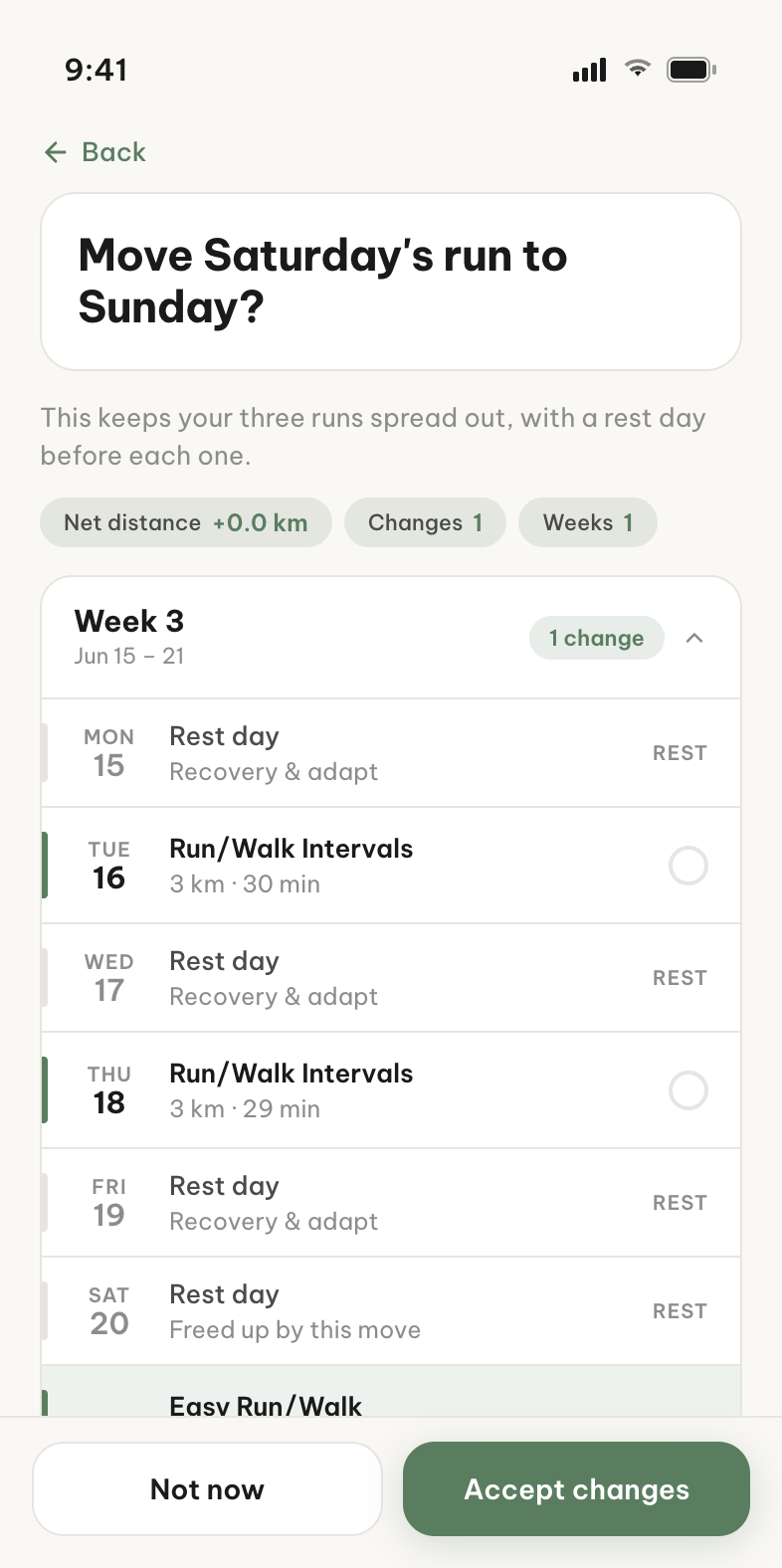
- The plan reflows when a day stops working. If Wednesday becomes impossible, the run moves and the surrounding week rebalances. You see the changes before you accept them.
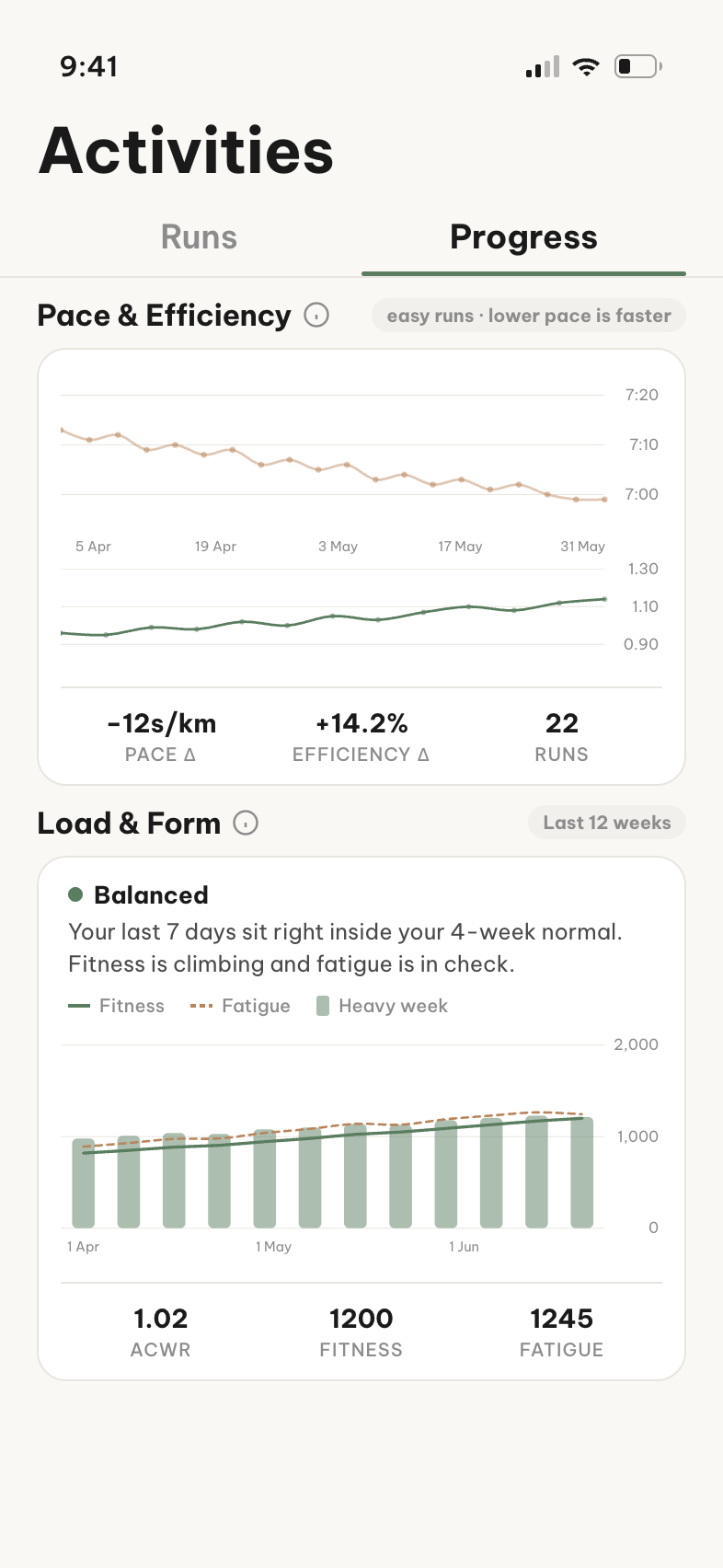
- Training load tracking shows whether your frequency is absorbing. Load and recovery trends make it visible when your current number of days is building fitness, and when it is just building fatigue.
A plan built on the days you actually have
Tell Miles which days you can run and it structures 5K to marathon training around them. Available on iPhone.