 Miles
Miles Race training
Marathon Training Plan for Beginners: The 16-Week Build
A first marathon is not a longer half. It is a different project: bigger long runs, deliberate recovery weeks, a real taper, and a fueling plan. Here is what a beginner marathon training plan looks like, week by week, and the mistakes that end most first attempts.
Who is ready to start marathon training?
The marathon rewards a base and punishes the lack of one. Before starting a 16-week build, you ideally want one of these two things:
- You are comfortable at the half marathon distance. You have run 13.1 miles21.1 km, in a race or in training, and recovered normally afterwards.
- You are running 20 or more miles30 or more kilometres per week, over four or more days, and have held that for at least a couple of months.
If neither is true yet, the smart move is to build to that base first, or pick a race further out. A marathon plan started from a thin base spends its first weeks doing base work anyway, and leaves less room to absorb setbacks.
Why 16 to 20 weeks?
Most beginner marathon plans run 16 to 20 weeks, and the length is not arbitrary. The long run needs to roughly double from where a base-fit runner starts, around 8 to 10 miles13 to 16 km, to a peak of 18 to 20 miles29 to 32 km. Growing it faster than a mile or two2 to 3 km per week, with periodic step-backs, outpaces what tendons, bones, and joints adapt to. Sixteen weeks is about the minimum that fits the whole arc: build, absorb, peak, taper. Twenty gives you slack for a cold, a work trip, or a niggle.
The long-run build
The long run is the marathon plan. Everything else supports it. Here is a typical 16-week progression:
| Week | Long run | Note |
|---|---|---|
| 1 | 8 miles13 km | Establish rhythm, all easy |
| 2 | 10 miles16 km | |
| 3 | 12 miles19 km | |
| 4 | 9 miles14 km | Cutback week |
| 5 | 13 miles21 km | Start practicing race fueling |
| 6 | 14 miles23 km | |
| 7 | 16 miles26 km | |
| 8 | 12 miles19 km | Cutback week |
| 9 | 17 miles27 km | |
| 10 | 18 miles29 km | Full race-day rehearsal: breakfast, gear, gels |
| 11 | 14 miles23 km | Cutback week |
| 12 | 19 miles31 km | |
| 13 | 20 miles32 km | Peak long run, about 32 kmPeak long run, about 20 miles |
| 14 | 14 miles23 km | Taper begins |
| 15 | 10 miles16 km | Taper continues |
| 16 | Race | Short easy runs, then 26.2Short easy runs, then 42.2 |
The peak sits around 18 to 20 miles (30 to 32 km)29 to 32 km (18 to 20 miles), two to three weeks before race day. You do not run 26.242.2 in training. The last 6 mileslast 10 km of the marathon are covered by the accumulated months of work plus a proper taper, not by one heroic training run that would cost more recovery than it returns.
The taper
The last two to three weeks reverse the logic of everything before them. Volume drops sharply, roughly 30 percent in the first taper week and half or less of peak in race week, while a small amount of faster running stays in to keep the legs sharp. Expect to feel worse before you feel better: taper weeks are famous for phantom niggles, restlessness, and the conviction that you are losing fitness. You are not. Fitness built over 13 weeks does not evaporate in two, but fatigue does, and that is the entire point.
The wall, and how fueling beats it
The famous wall around mile 20the 32 km mark is mostly a fuel problem. Your body stores roughly 90 minutes to 2 hours of glycogen at marathon effort; the race takes most beginners 4 to 5 hours. The difference has to come in through your mouth, during the run.
- Practice race nutrition on long runs, starting around week 5. A common target is 30 to 60 grams of carbohydrate per hour: gels, chews, or sports drink, with water.
- Rehearse the exact race-day setup on your 18-mile run29 km run: same breakfast, same gels at the same intervals, same shoes and kit.
- Never debut anything on race day. Your stomach trains like your legs do, and only on the runs where you practice.
Common first-marathon mistakes
- Racing the long run. Long runs are run well below race effort, a pace where you could hold a conversation. Running them hard turns the plan's biggest builder into its biggest injury risk and steals the recovery the rest of the week depends on.
- Skipping recovery weeks. Cutback weeks feel like doing less. They are how the doing-more gets absorbed. Treat them as scheduled, not optional.
- Cramming missed miles.Cramming missed kilometres. Miss a week and the instinct is to stack it onto the next one. That turns a small fitness cost into a large injury risk. Rejoin the plan where it is, at slightly reduced volume; our missed-week guide covers exactly how.
- Ignoring fueling until race day. See above. The wall is optional, but only if you rehearse.
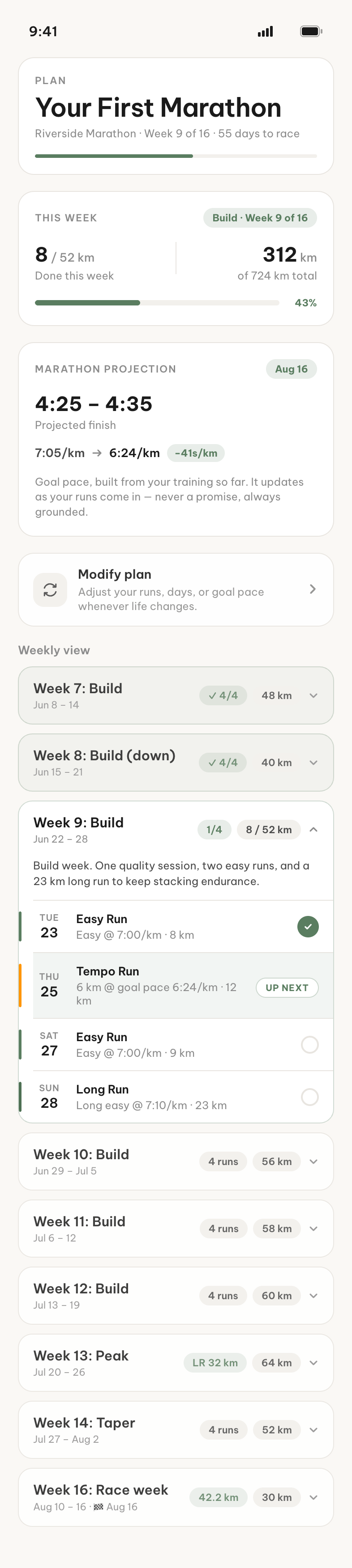
How Miles trains you for a marathon
A template plan assumes an average runner having an average four months. Miles builds and runs the plan around your actual training.
- Marathon plans with a long-run build and a recovery-aware taper. The progression, cutback weeks, and taper above are built in, sized from your current fitness and race date.
- Tight timeline? The plan adjusts without rushing you into injury. If your race is closer than ideal, Miles sizes the build to the time available rather than compressing the risky parts.
- Live pacing on long runs. Audio cues tell you when you drift off target or push too fast, which is exactly the discipline long runs demand.
- Post-run analysis with next-step guidance. Every session ends with a breakdown of what you ran versus what was planned, and a clear next step: recover, push, or adjust.
Start your marathon build with a coach in your pocket
Miles builds your marathon plan from where you are today, paces your long runs live, and adapts when your weeks change. Available on iPhone.