 Miles
Miles Pacing
What Pace Should a Beginner Run?
Slower than feels natural. That is the whole answer, and almost every beginner gets it wrong in the same direction. Here is how to find your easy pace without a lab test, and why running slower is the fastest way to get faster.
The answer: slower than feels natural
There is no universal beginner pace. A comfortable pace for one new runner is a sprint for another, and both are fine. What is universal is the effort: most of your running should happen at an effort so relaxed it feels almost too slow. If you finish a run and think "I could have gone much faster," you paced it correctly.
The reason this feels wrong is that running has a natural default speed, the pace your legs fall into when you do not think about it. For nearly everyone, that default is too fast for easy running. Easy pace is a deliberate choice, and at first it takes discipline to hold.
The talk test
The simplest pacing tool ever invented needs no watch. While running, try to speak out loud in full sentences.
- Full, flowing sentences: you are at easy pace. This is where most of your running belongs.
- Short phrases, a few words between breaths: you have drifted into steady or tempo effort.
- One word at a time, or no words: that is hard interval effort, which has a place, but not on an easy day.
Running alone? Recite something quietly, or hum. If you feel silly doing it, good: the pace is probably right.
Why beginners run everything too fast
Almost every new runner trains in the same dead zone: too fast to be easy, too slow to be a real workout. It feels productive because every run ends breathless and sweaty. But it stalls progress for two reasons.
First, the aerobic system, which powers the overwhelming majority of all running from 5K to marathon, develops best at low intensity. Run everything at medium-hard and you never give that system the long, relaxed stimulus it grows from. Second, medium-hard running generates real fatigue, so you arrive at every run slightly cooked, paces plateau, motivation drains, and impact-related injuries, shin splints, sore knees, angry calves, start queueing up. The frustrating result: months of hard-feeling running with little to show for it.
Pace bands, by effort and breathing
Actual paces are personal: they depend on your fitness today and they change as you improve. What stays constant is what each band feels like. Learn the bands by feel and you can pace yourself anywhere, watch or no watch.
| Band | Effort | Breathing and talking | Role in training |
|---|---|---|---|
| Easy | Relaxed, almost restful | Nose-or-mouth breathing, full sentences | The bulk of all your running; builds the aerobic engine |
| Steady | Comfortably working | Deeper breathing, sentences shorten | Long-run finishing sections, gentle progressions |
| Tempo | Comfortably hard, controlled | Rhythmic and heavy, a few words at a time | One session a week at most; raises the pace you can sustain |
| Interval | Hard, near your limit for minutes | Talking is off the table | Short reps with recoveries; sharpens speed and economy |
The 80/20 principle, in plain terms
Study elite runners in any endurance sport and the same split appears: roughly 80 percent of their training is easy, and only about 20 percent is genuinely hard. Not because they lack ambition, but because that ratio is what makes the hard 20 percent count. Easy volume builds the engine; the small dose of hard work tunes it.
Beginners tend to invert this without noticing, running something like 80 percent medium-hard. The fix is simple to state: make your easy days genuinely easy, so your hard days can be genuinely hard. Two different runs, two different jobs.
How to know your "easy" is too hard
One more sign: pride in the pace. If you catch yourself speeding up so the watch shows a rounder number, you are racing your own training. The pace on an easy day is not the result. The relaxed effort is.
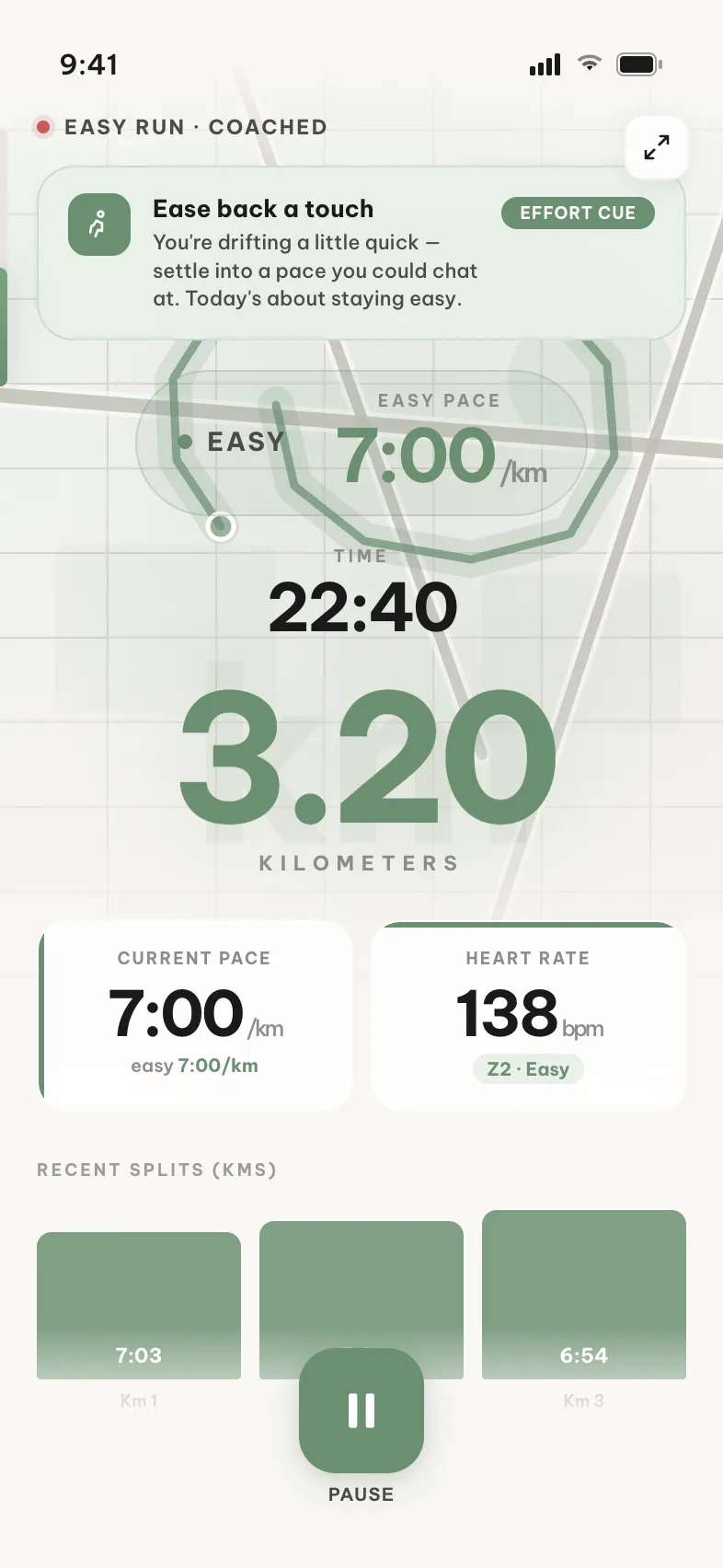
How Miles takes the guesswork out of pacing
Everything above works by feel. Miles adds the numbers, calibrated to you.
- A target pace for every session, from your data. Miles sets the pace for each run based on your current fitness, so "easy" and "tempo" are specific numbers for your body, not someone else's chart.
- Live audio cues keep you in the band. Drift off target pace, or push way too fast, and Miles tells you in your ear mid-run, which is exactly when beginners need the nudge.
- Every session explains its purpose. The session screen tells you what the run is for and why it is paced the way it is, so slow days stop feeling like wasted days.
- Post-run analysis shows whether you stayed in range. After each run you see what you ran against what was planned, pace, splits, and heart rate included, so the feel of easy gets calibrated against evidence.
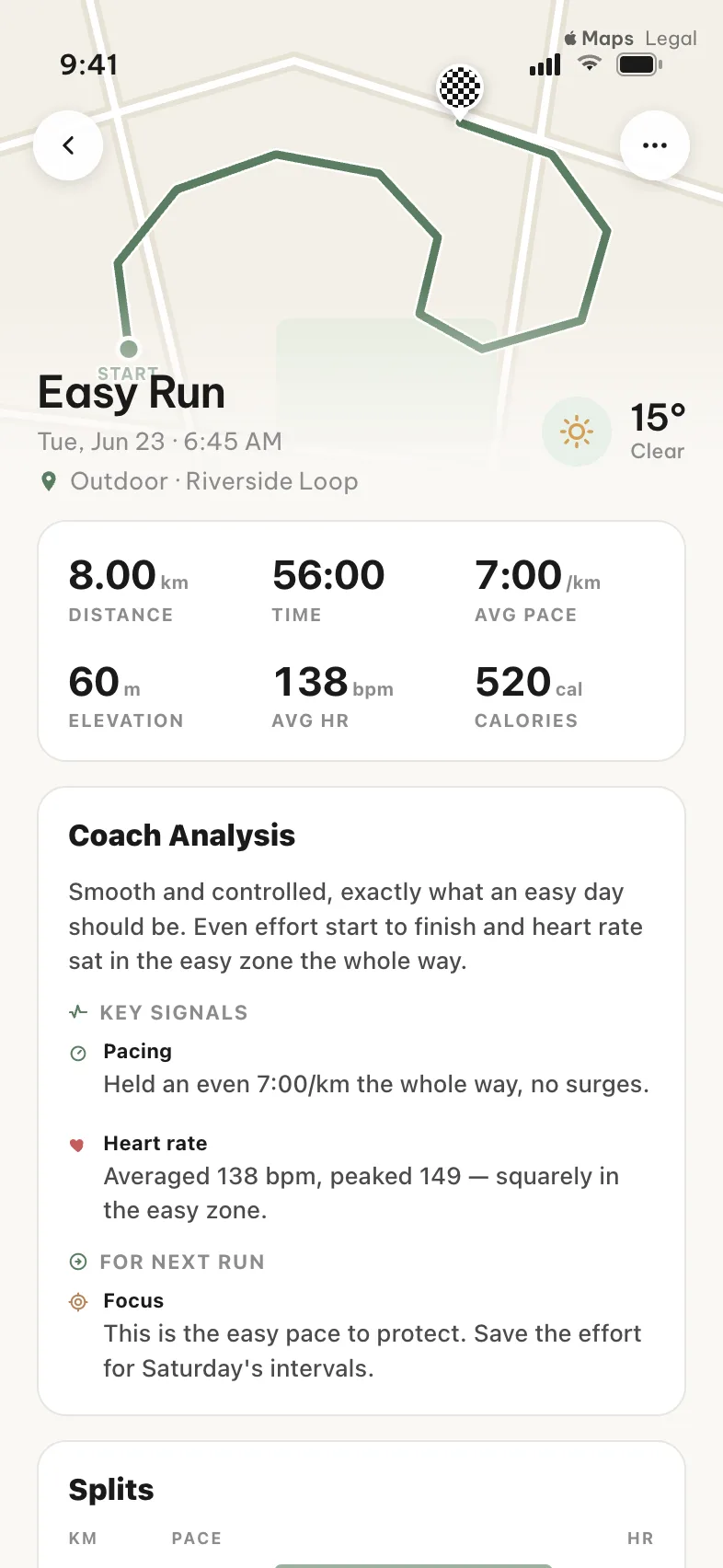
Run every session at the right pace
Miles sets your paces, coaches you live when you drift, and shows you afterwards how you did. Available on iPhone.