 Miles
Miles First 5K
Couch to 5K Training Plan: A Realistic Guide for Absolute Beginners
Couch to 5K is the most popular way to start running, and for good reason: it works. But the classic version also loses most of the people who start it. Here is the full progression, plus the adjustments that keep you in the game when a week does not go to plan.
What couch to 5K actually is
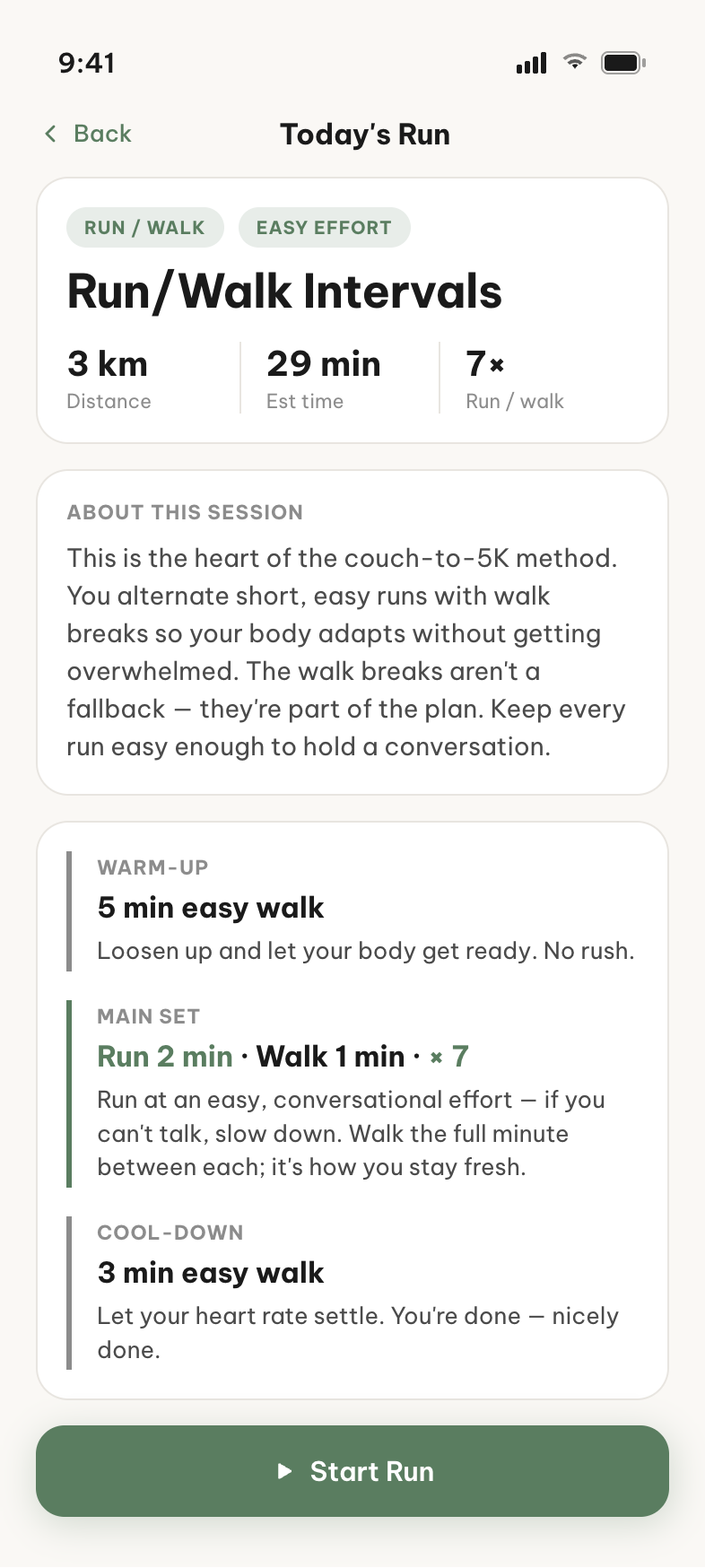
Couch to 5K is a run-walk program that takes you from no running at all to running 5 kilometres, about 30 minutes, without stopping. Instead of asking you to run continuously on day one, it alternates short running intervals with walking recoveries, three sessions a week. Each week the running intervals get a little longer and the walking breaks get a little shorter, until the walks disappear entirely.
The walking is not cheating. It is the mechanism. Run-walk intervals let your heart, lungs, muscles, and especially your tendons and joints adapt gradually. Connective tissue adapts more slowly than cardiovascular fitness, which is why beginners who feel fine aerobically still pick up shin and knee complaints when they ramp too fast.
A realistic 10-week progression
Below is a run-walk progression built on the same logic as classic couch to 5K, stretched to 10 weeks so the jumps between weeks are smaller. Do each session three times in the week, with at least one rest day between runs. Every session starts with a 5 minute brisk walk to warm up and ends with a 5 minute walk to cool down.
| Week | Session (3x per week) | Total running |
|---|---|---|
| 1 | Run 1 min / walk 90 sec × 8 | 8 min |
| 2 | Run 90 sec / walk 90 sec × 7 | 10.5 min |
| 3 | Run 2 min / walk 90 sec × 6 | 12 min |
| 4 | Run 3 min / walk 90 sec × 5 | 15 min |
| 5 | Run 5 min / walk 2 min × 4 | 20 min |
| 6 | Run 8 min / walk 2 min × 3 | 24 min |
| 7 | Run 10 min / walk 2 min × 2, then run 5 min | 25 min |
| 8 | Run 15 min / walk 2 min / run 10 min | 25 min |
| 9 | Run 25 min continuous | 25 min |
| 10 | Run 30 min continuous | 30 min, roughly 5K |
Run every interval at a pace where you could speak in full sentences. If you finish a running interval gasping, the pace was wrong, not the plan. Most beginners run their intervals far too fast, which makes week 3 feel like week 8 and makes quitting feel rational.
Why so many people quit couch to 5K
The dropout problem is real and it is measured. A 2023 peer-reviewed study by Relph and colleagues, published in the International Journal of Environmental Research and Public Health, followed participants through a standard nine-week couch to 5K program and found that only 27.3 percent completed it. The researchers linked the dropout to the program's fixed, rapid weekly progression: the plan increased the running load on a set schedule regardless of how each individual was actually coping.
That is the core weakness of any printed plan. Week 5 arrives on the calendar whether or not your body finished adapting to week 4. If you were sick, slept badly, or simply needed more time at a given interval length, a rigid program has no answer except "do the next week anyway." People do not fail couch to 5K because they lack willpower. They fail because the plan refuses to meet them where they are.
The mistakes that end a couch to 5K attempt
- Running the intervals too fast. This is the number one plan killer. The goal of each interval is to finish it feeling like you could have done one more, not to prove anything. Slow down until it feels almost too easy.
- Repeating a hard week on a loop. If week 5 keeps beating you, running the identical week a third and fourth time hoping it clicks is just running into the same wall. What you need is a smaller step between week 4 and week 5, for example run 4 minutes instead of 5, not more collisions with the same jump.
- Treating a bad week as proof you are not a runner. One rough week after poor sleep, stress, or illness says nothing about your potential. The 27.3 percent completion figure tells you the standard plan is fragile, not that you are.
- Skipping rest days. Enthusiasm in week 2 becomes shin pain in week 4. Three run days a week is the plan because the days in between are where adaptation happens.
- Ignoring the warm-up walk. Five minutes of brisk walking before the first run interval measurably changes how the first interval feels. Beginners who skip it judge the whole session by a miserable first minute.
What to do after you finish
Once you can run 30 minutes continuously, hold there for two to three weeks before adding anything. Then you have options: run the same three days but a little longer, add a fourth short run, or point the fitness at a goal like a faster 5K or a first 10K. Our guide on how many days a week to run covers the next step.
How Miles builds your couch to 5K
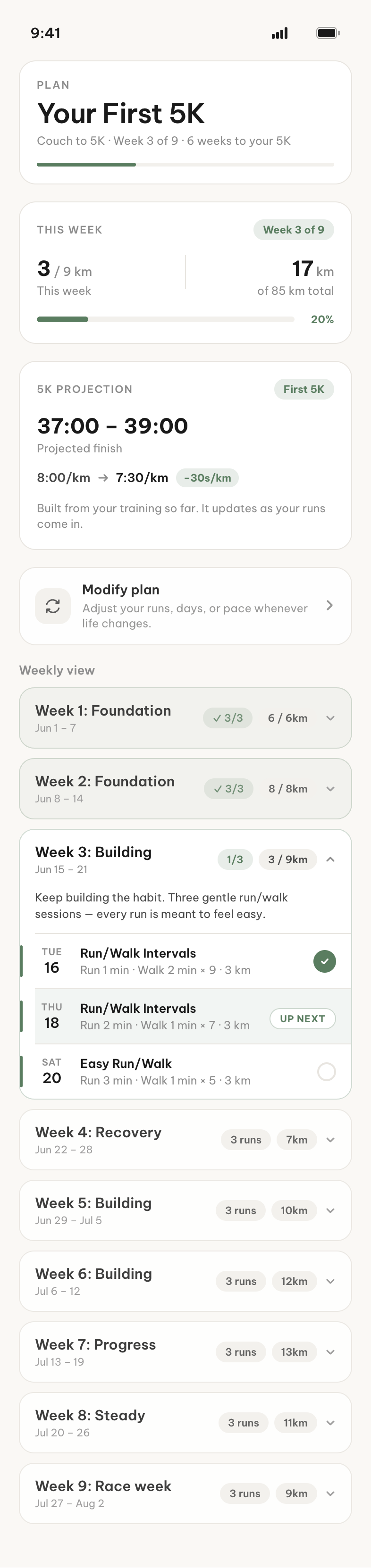
Everything above is the manual version: pick a progression, run by feel, and make your own judgement calls when a week goes sideways. Miles does that judgement work for you.
- The progression starts from your actual fitness. Miles builds your plan from where you are today, not from a generic week 1. If you already walk regularly, you skip the parts you do not need. If you are starting from zero, the first weeks are sized for that.
- The plan adapts week to week. Instead of a fixed jump arriving on the calendar, Miles adjusts the next week based on how you are actually coping: easing off when you are lagging behind and progressing faster when you are handling the load well. The fixed rapid progression that drove dropout in the research simply is not how the plan works.
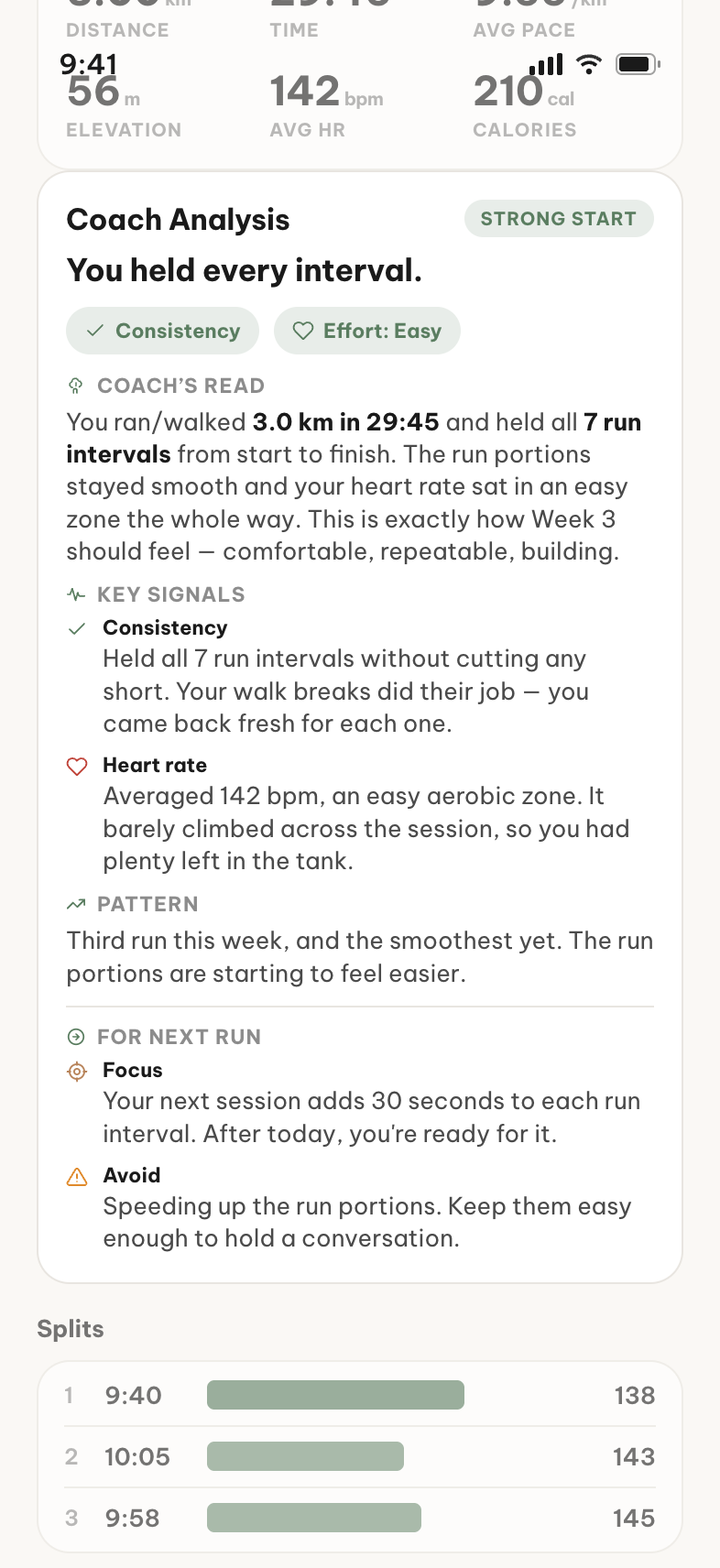
- Live audio cues run the intervals for you. During run-walk sessions, Miles calls out each interval as it starts and tells you when you are pushing way too fast, so you never have to stare at a watch or guess the pace.
- You see progress after every session. The moment you finish, Miles shows you a clear summary of what you ran versus what was planned, and tracks every run against your goal so the improvement is visible week by week.
Start couch to 5K with a plan that adjusts to you
Miles builds your run-walk progression from your actual starting point and adapts it as you go. Available on iPhone.